Requesting a Call:
Online Support
A truly cost-effective irrigation system does not mean the cheapest price tag. It means the lowest total cost of ownership — equipment, water, energy, labor and maintenance — while protecting the yield that pays for it all. This guide takes you step by step from field assessment to supplier selection, so you can build a system that pays for itself year after year.
Step 1 — Start with Your Field, Not the Brochure
Every irrigation decision should start with the land you actually have. Two farms with the same budget rarely need the same system, because field shape, soil and water supply change everything. Before you look at any equipment, answer these six questions:
●Field shape & size — Is the plot square, rectangular or irregular? What are its length × width, in acres or hectares? Shape determines whether a rotating, travelling or static system makes sense.
●Soil type — Sandy, clay, loam or a mix? Soil texture sets the speed at which water can be absorbed, which directly affects sprinkler selection and application rates.
●Crop type — Wheat, corn, forage, potato or others? Crop height and row spacing influence nozzle choice, sprinkler height and whether drip irrigation is the right fit.
●Water source conditions — Wells, rivers or reservoirs? You need both the volume available and the quality, because corrosive or sediment-heavy water changes pipe and component requirements.
●Terrain slope — Flat or hilly? Slope determines which systems are safe and efficient on your land.
●Electricity / energy supply — Can the system be grid-powered, or does it need a diesel generator or solar power?
Tip: If you already have plot data — area, shape and crops — a reputable manufacturer can turn it into a preliminary plan quickly. GENGZE, for example, provides a preliminary irrigation plan within 24 hours from your field details, and where more accuracy is needed, sends agricultural engineers on-site to carry out soil sampling and topographic mapping so the plan is precisely matched to your land.
Step 2 — Match the Technology to Your Field and Your Budget
Irrigation systems are not interchangeable. Each technology has a sweet spot where it delivers the lowest cost per hectare. Buying a system that "sort of fits" your field usually means paying for water, energy and labor you never recover.
●Center pivot irrigation
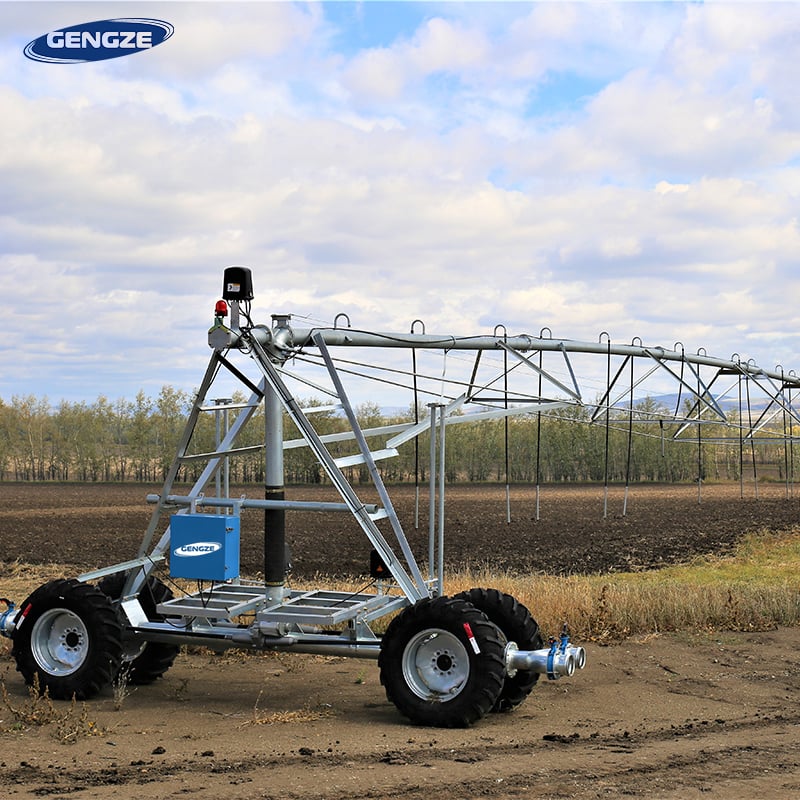
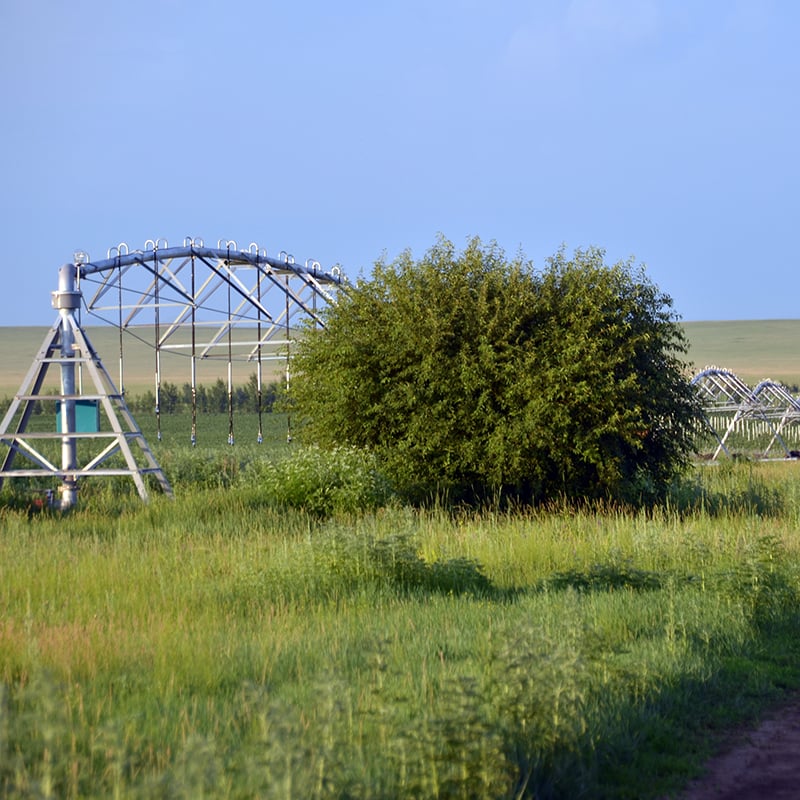
The workhorse for large-scale farming. A center pivot rotates 360° around a concrete base, irrigating the entire field with minimal labor. It is the most efficient option for large square or round plots with a terrain slope of up to 25°, and at scale it delivers the lowest labor cost per hectare. For very large flat fields, it is hard to beat on total cost.
●Linear (lateral move) irrigation
Where center pivots rotate, linear systems travel back and forth in straight, parallel paths. This makes them the right choice for rectangular, narrow or long plots — including L-shaped fields — because they cover the full plot with no dead angles. Water is delivered through a flexible hose or HDPE pipe connected to a swivel joint, and the system can be generator-powered for remote sites.
●Hose reel irrigator
The low-initial-cost, highly flexible option. A hose reel machine is compact, mobile and simple to operate, and it suits fields of any size, shape and slope — including those with obstacles. It can be driven by water turbine, hydraulics, electricity or even solar, and configured with a single gun, double guns or a spray boom. It is a strong choice for small- to medium-sized or irregular farms. (Note: for best performance, avoid heavy clay soils.)
| System | Best for | Cost profile | Key trade-off |
| Center pivot | Large square / round fields, slope ≤ 25° | Higher upfront, lowest per-hectare labor at scale | Needs large, relatively uniform plots to justify cost |
| Linear / lateral move | Rectangular, narrow, long or L-shaped fields | Moderate; full coverage, no dead angles | Requires straight-line travel and water feed |
| Hose reel irrigator | Any shape or slope, small to medium fields, obstacles | Low initial cost, compact, mobile | Not ideal on heavy clay; speed is per-lane |
Step 3 — Design for Water and Energy Efficiency
Once the technology fits the field, the next cost lever is how efficiently the system turns water into yield. Four details make a measurable difference:
●Respect soil infiltration rates. In sprinkler irrigation, the application rate must never exceed the soil's infiltration rate. Exceeding it causes surface ponding and runoff — wasted water, wasted energy, and in the worst case, damaged crop growth and reduced yield. Matching nozzle output to your soil is a free cost saving.
●Keep sprinklers close to the canopy. Low-profile sprinkler designs positioned near the crop canopy reduce water loss from wind and evaporation, and increase application rate per hour — more water in the root zone, less lost to the air.
●Use precision pressure regulators. Regulators keep each nozzle at its design pressure for uniform distribution, and anti-clogging designs prevent the blockages that cause dry spots and waste. Uniformity is efficiency.
●Integrate fertigation where it fits. Combining irrigation with fertilization delivers nutrients in precise, timed amounts directly to the root zone. It accelerates nutrient uptake, prevents volatilization losses from surface application, reduces environmental impact and improves fertilizer-use efficiency — one pass of the machine doing two jobs.
Power and water supply are part of the same equation. If grid power is unavailable or expensive, an off-grid option such as a solar water pump system (which can draw from deep wells, rivers, lakes and reservoirs, with automatic start/stop and remote monitoring) or a diesel generator / diesel pump set can keep irrigation running at a predictable cost.
Step 4 — The Hidden Cost Driver: Components and Materials
The price list is only the beginning. Over a 10-year life, maintenance, downtime and premature replacement usually cost far more than the difference between a good and a bargain system. Pay attention to what the machine is actually made of:
●Main-line pipe quality. A typical high-end pivot mainline is 6-5/8" (168 mm) high-frequency welded carbon steel. Look for wall thickness above industry standards (GENGZE's is about 10% thicker) and hot-dip galvanizing to marine-grade specifications, so the structure survives years of weather and water contact.
●Corrosion protection for tough water. If your water is harsh or corrosive, a rubber lining inside the pipe adds an extra layer of protection against fertilizer and agrochemical corrosion — an inexpensive insurance policy that can double the life of the system.
●Supply pipework. For the water feed, HDPE (high-density polyethylene) pipe is lightweight, durable, flexible and economical, and it is widely used in farmland irrigation and water-saving agriculture.
●Sprinklers and spray guns. These are the parts that wear. Choose proven designs with long-life, permanently lubricated bearings and simple repairability. A dependable big gun with stable, slow rotation covers more ground with less maintenance than a cheap unit that needs replacing.
●Controls that save labor. A smart control panel with real-time sensor data (temperature, humidity, wind, rainfall, flow), fault alerts and GPS tracking lets one person manage many machines. With IoT remote monitoring, you can control the entire system from a phone or computer — fewer trips to the field, less overtime, less downtime.
Step 5 — Don't Forget Installation, Training and After-Sales
Irrigation equipment is only as good as its installation and the people running it. Before you sign, confirm what happens after delivery:
●Installation and commissioning — who sets it up and checks it works?
●Operator training — will your team be trained to run the system independently and do basic maintenance?
●Spare parts and inventory — is there a well-stocked spare-parts warehouse with standardized inbound/outbound procedures, so repairs never stall the season?
●Technical support — is there an experienced after-sales technical team available when something goes wrong?
These services are not a bonus; they are part of the total cost equation. A machine that stops for three weeks during peak season is far more expensive than the cheapest quote ever saved.
Step 6 — Verify the Supplier Before You Commit
Finally, evaluate the manufacturer itself. A few checks separate reliable partners from risky ones:
●Independent certification. Does the factory hold recognized certification such as CE, verified by a third party such as TÜV?
●Factory-direct supply. Buying directly from the manufacturer usually means a more competitive price and clearer communication than going through many intermediaries.
●Flexible order sizes. Can you start with a small order — even a single set — at a fair price, rather than being forced into a large commitment?
●Delivery discipline. Does the supplier commit in the contract to shipping on time, without delay?
●Third-party inspection. Will they accept independent quality inspection of the goods before shipment?
●Proven track record. Ask for production capability (factory scale, manufacturing equipment such as laser cutting, CNC and forging lines) and export experience.
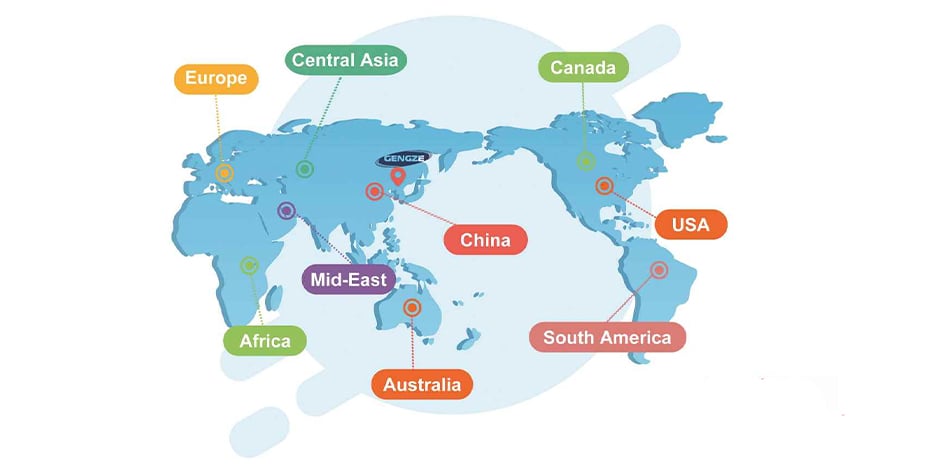
As a reference point: GENGZE is one of China's top five agricultural equipment manufacturers, operating a 64,000 m² factory in Dalian with advanced laser cutting, CNC and forging capability. Its irrigation equipment carries multiple CE certifications (TÜV-verified), it supplies factory-direct with small orders accepted, and it exports year-round to customers across Europe, Oceania and Africa.
Your Procurement Checklist
1.Record field shape, dimensions and acreage; soil type; crop type; water source volume and quality; slope; and energy supply.
2.Shortlist the technology that fits your field and budget (pivot, linear, hose reel, side roll, drip).
3.Confirm water and energy efficiency: application rates vs. soil infiltration, sprinkler height, pressure regulation, fertigation needs.
4.Specify quality materials: pipe wall thickness and galvanizing, corrosion protection, HDPE supply pipe, durable sprinklers and guns, smart controls.
5.Verify installation, operator training, spare-parts availability and after-sales support.
6.Vet the supplier: certifications, factory-direct pricing, order flexibility, delivery discipline, third-party inspection, track record.
7.Ask for a tailored proposal and, if possible, a preliminary plan or on-site survey before committing.
 Hot News
2026-10-13
2026-10-08
2026-09-29
2026-09-22
2026-09-03
2026-08-28
Dalian Gengze Agricultural Equipment Manufacturing Co.,Ltd
Copyright © Dalian Gengze Agricultural Equipment Manufacturing Co.,Ltd All Rights Reserved | Blog | Privacy Policy
 EN
EN